
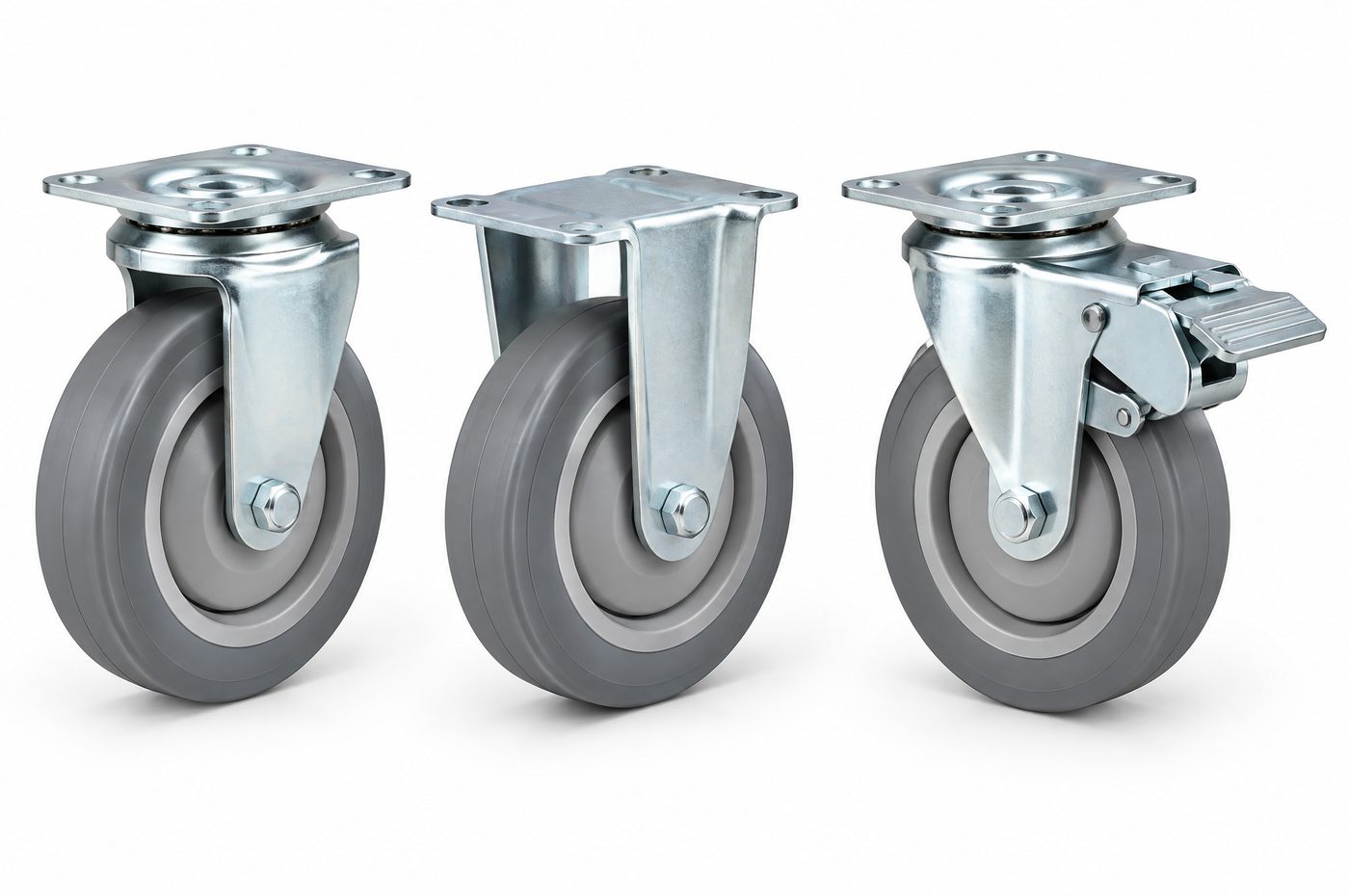
Castor function is as important as load capacity. The right combination makes equipment easy to push, steer and park.
Swivel castors
Swivel castors rotate 360 degrees around a swivel head with ball bearings. They let equipment turn in tight spaces and are usually fitted at the handle end of a trolley.
Rigid (fixed) castors
Rigid castors roll in one direction only. They help trolleys track straight over long distances and are easier to push in a straight line.
Brake options
- Side brake: a pedal presses on the wheel tread to stop it rolling.
- Total brake (total lock): locks both the wheel and the swivel head, so the equipment cannot roll or rotate. Ideal for workstations and scaffolding.
- Central lock and directional lock: used on hospital beds. One pedal locks all castors, or sets them to track straight for easier transport along corridors.
A typical setup
For most platform trolleys we recommend two swivel castors with brakes at the handle end and two rigid castors at the far end. For equipment that must move in every direction, use four swivel castors with at least two brakes.
Need help choosing? Our team offers free consultation on castor selection.