
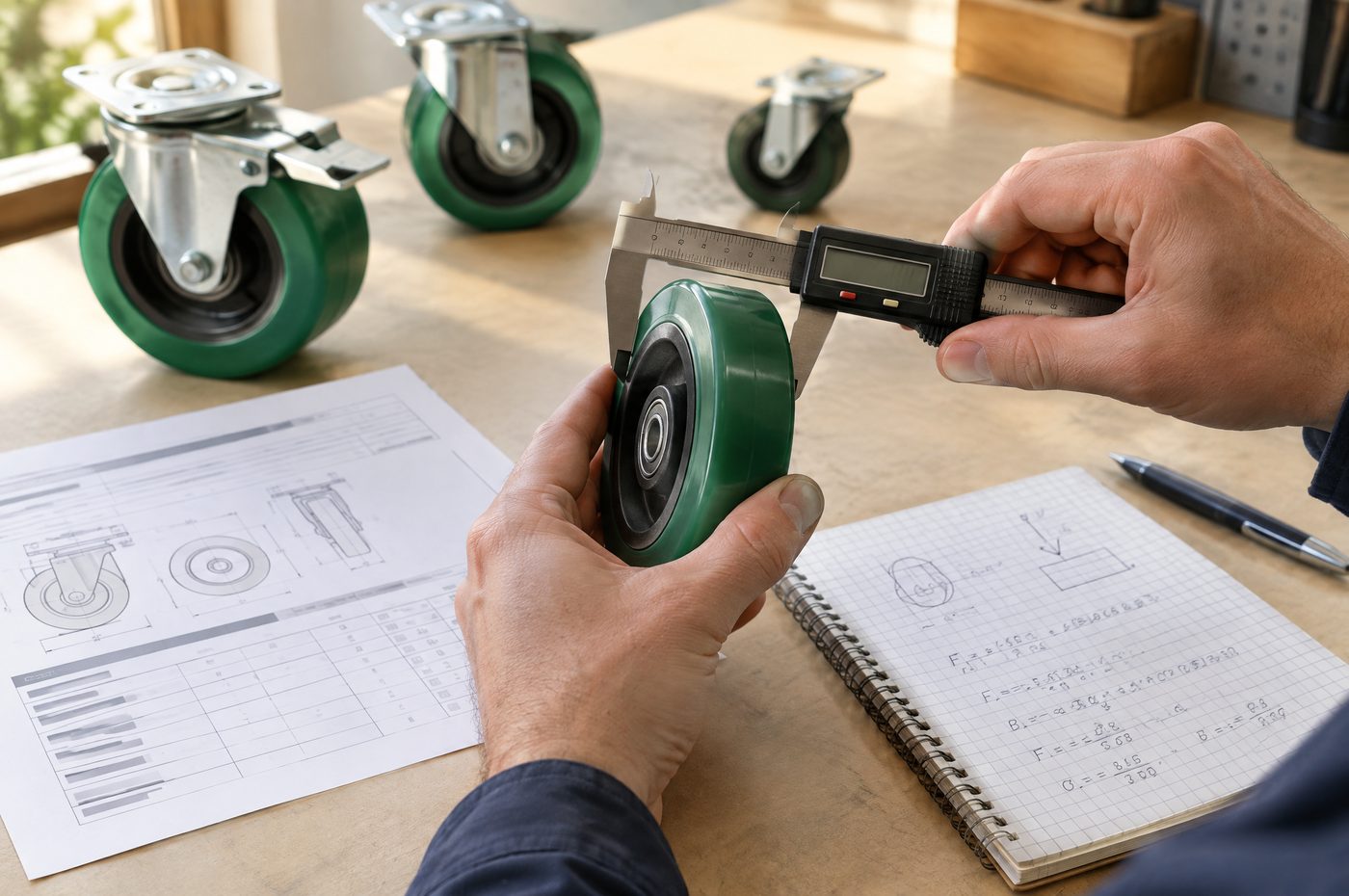
The wrong castor costs more than its price tag. Wheels that flat-spot, brackets that bend and treads that mark your floor all lead to downtime, replacements and unsafe handling. Choosing the right castor comes down to four questions.
1. How much load does each castor carry?
Add the weight of the equipment to the heaviest load it will carry. Then divide by the number of castors minus one. On real floors one castor is often slightly off the ground, so the other three take the weight.
Example: a trolley weighing 100 kg carrying 500 kg on four castors: (100 + 500) / 3 = 200 kg per castor. Choose castors rated at 200 kg or more.
If the trolley is pushed over bumps, ramps or expansion joints, add a further safety margin.
2. What floor will it roll on?
- Smooth epoxy, vinyl or tiles: polyurethane (PU), TPR or grey rubber wheels are quiet and non-marking.
- Rough concrete or outdoors: rubber, elastic rubber or pneumatic wheels absorb shocks.
- Very heavy loads on hard floors: nylon, cast iron or phenolic wheels give the lowest rolling resistance.
3. What is the environment?
Heat, water, chemicals and hygiene rules change the choice completely. Bakeries and ovens need heat resistant wheels. Food processing and pharmaceutical plants need stainless steel brackets. Electronics assembly needs antistatic or conductive castors to discharge static safely.
4. How will it be mounted and controlled?
- Top plate: the most common mounting. Match the plate size and bolt hole centres.
- Threaded or plain stem: for furniture, medical equipment and compact trolleys.
- Swivel, rigid or brake: a typical trolley uses two swivel and two rigid castors for easy steering, with brakes where the equipment must stay put.
Not sure? Ask us
Revo Castor Wheels offers free consultation on castor selection. Send us the load, floor, environment and a photo of your equipment, and we will recommend the most suitable castor for performance and cost.